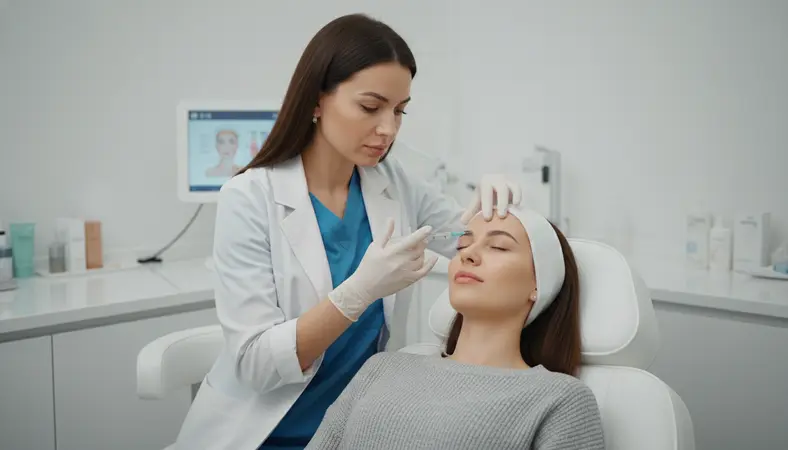
Accurate Botox dosing is one of the most critical skills a new injector must develop. Too few units and the patient sees no improvement; too many and you risk an unnatural, frozen appearance or adverse effects like brow ptosis or eyelid drooping. The ability to select the right dose for each patient, in each treatment area, is what separates a competent injector from an exceptional one.
This clinical guide provides detailed dosing recommendations for the most commonly treated areas, along with critical information about dilution ratios, injection depth, and onset timing that every practitioner needs to understand.
Reconstitution and Dilution
OnabotulinumtoxinA (Botox Cosmetic) is supplied as a 100-unit vial of vacuum-dried powder. Before use, it must be reconstituted with preservative-free 0.9% normal saline. The dilution ratio you choose directly affects the volume delivered per unit and the spread of the toxin at the injection site.
The most common dilution ratios and their concentrations are:
- 1.0 mL saline per 100 units: yields 10 units per 0.1 mL. This concentrated dilution minimizes spread and is useful for precise, targeted treatments.
- 2.0 mL saline per 100 units: yields 5 units per 0.1 mL. This is a common middle-ground dilution used by many practitioners.
- 2.5 mL saline per 100 units: yields 4 units per 0.1 mL. This is the most widely used dilution for cosmetic applications, providing good volume for even distribution.
- 4.0 mL saline per 100 units: yields 2.5 units per 0.1 mL. This more dilute preparation is sometimes used for broad, superficial treatments such as platysma bands or the "Botox facial" microdroplet technique.
When reconstituting, gently inject the saline along the inner wall of the vial. Do not shake or agitate the vial, as excessive force can denature the botulinum toxin protein and reduce its efficacy. Once reconstituted, Botox should be stored refrigerated at 2 to 8 degrees Celsius and used within 24 hours, though some studies suggest potency is maintained for up to 6 weeks when properly stored.
Forehead Lines (Frontalis)
The frontalis muscle is the sole elevator of the brow, making it one of the most important muscles to dose correctly. Over-treatment leads to brow ptosis and a heavy, expressionless appearance. Under-treatment leaves visible horizontal rhytids that frustrate the patient.
Recommended Dosing
- Female patients: 10 to 20 units total, distributed across 4 to 8 injection points
- Male patients: 15 to 30 units total, distributed across 6 to 10 injection points
- Injection depth: Intramuscular, into the belly of the frontalis
- Placement: At least 2 cm above the orbital rim to prevent brow ptosis
A critical clinical pearl: always treat the glabella first or simultaneously when treating the forehead. The glabellar complex (corrugator supercilii, procerus, and depressor supercilii) pulls the brow downward. If you weaken the frontalis without addressing these depressors, the net effect is a heavier, lower brow. Conversely, treating the glabella alone often provides some forehead smoothing as the brow elevates slightly from reduced depressor activity.
Glabellar Complex (Frown Lines)
The glabellar complex, commonly referred to as the "11 lines" or frown lines, was the first cosmetic indication approved for Botox in 2002. This area involves three muscles: the corrugator supercilii (paired muscles that draw the brow medially and inferiorly), the procerus (a midline muscle that pulls the medial brow downward), and the depressor supercilii.
Recommended Dosing
- Standard dose: 20 units total using the classic 5-point injection pattern
- Distribution: 4 units per site — 1 injection into the procerus, 2 into each corrugator (medial and lateral heads)
- Male patients: May require 25 to 40 units due to larger muscle mass
- Injection depth: Intramuscular, perpendicular to the skin at the procerus; angled superolaterally along the corrugator
When injecting the corrugator, palpate the brow to identify the muscle body and note the supraorbital notch. Injection should remain at least 1 cm above the orbital rim. The lateral corrugator injection should angle slightly upward and away from the orbit to minimize risk of toxin diffusion to the levator palpebrae superioris, which can cause eyelid ptosis.
Crow's Feet (Lateral Canthal Lines)
Crow's feet are caused by contraction of the lateral fibers of the orbicularis oculi muscle. This is a superficial muscle, and injection should be intradermal to superficial intramuscular to achieve optimal results while minimizing spread to deeper structures.
Recommended Dosing
- Female patients: 8 to 16 units per side (3 to 4 injection points)
- Male patients: 12 to 20 units per side
- Injection depth: Superficial intramuscular or intradermal
- Placement: At least 1 cm lateral to the orbital rim, in a fan-shaped pattern
Inject while the patient is squinting to identify the lines and muscle activation pattern. Place injections at least 1 cm lateral to the bony orbital rim to prevent toxin migration into the orbit. Avoid injecting below the level of the zygoma, as this can affect the zygomaticus major and cause an asymmetric smile.
Masseter Reduction
Masseter Botox serves both therapeutic (TMJ pain, bruxism) and aesthetic (facial slimming) purposes. The masseter is a thick, powerful muscle, and adequate dosing is essential for visible results. This treatment has grown enormously in popularity due to the trend toward a more tapered, V-shaped jawline.
Recommended Dosing
- Cosmetic slimming: 25 to 50 units per side
- TMJ/bruxism: 25 to 50 units per side (sometimes higher for severe cases)
- Injection depth: Deep intramuscular, into the thickest portion of the masseter belly
- Distribution: 3 to 6 injection points per side, distributed across the lower two-thirds of the muscle
Have the patient clench their teeth to identify the masseter borders. Injections should stay within the lower two-thirds of the muscle to avoid affecting the zygomaticus major (which can impair smile) and to remain below the parotid duct. Full aesthetic results from masseter Botox may take 4 to 6 weeks and become more pronounced with repeated treatments as the muscle undergoes progressive atrophy. Learn more about this application in our TMJ Injection Therapy Course.
Platysma Bands (Nefertiti Lift)
The platysma is a thin, broad muscle that extends from the chest to the lower face. With aging, its anterior bands become prominent, creating visible vertical cords in the neck. Botox injection along these bands, sometimes called the "Nefertiti Lift," can soften their appearance and provide subtle jawline definition.
Recommended Dosing
- Platysma bands: 2 to 5 units per injection point, 4 to 6 points per band
- Total dose: 20 to 60 units depending on the number and prominence of bands
- Injection depth: Superficial intramuscular, directly into the band
Have the patient grimace or tense their neck to accentuate the bands. Grasp each band between your fingers and inject directly into the muscle. Take care to avoid deep injection, as the external jugular vein and other vital structures lie beneath the platysma. This is an advanced technique best attempted after you have developed proficiency with upper face injections.
Onset Timing and Duration
Understanding the timeline of Botox effects is essential for managing patient expectations and scheduling follow-up appointments. The onset and duration vary slightly by treatment area and individual patient factors.
- Initial onset: 24 to 72 hours after injection (patients may notice subtle changes)
- Clinical effect: 7 to 14 days for full effect to develop
- Duration: 3 to 4 months for most patients in most treatment areas
- Masseter: May last 4 to 6 months due to gradual muscle atrophy
- Hyperhidrosis: May last 6 to 12 months
Schedule a follow-up appointment at 2 weeks to assess results and perform touch-ups if needed. This is a critical step for new patients and helps build the patient relationship. Patients who return for follow-up are also more likely to rebook for their next full treatment.
Developing confident, precise dosing skills requires hands-on clinical experience under expert guidance. Our Botox Certification Course and Advanced Botox and Filler Training programs provide the supervised live-patient experience needed to refine your dosing technique and build the clinical judgment that comes only from practice.