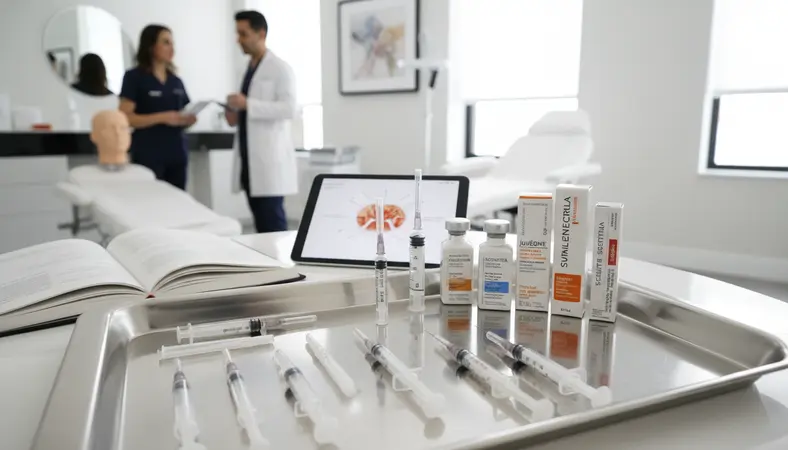
One of the most important clinical decisions an injector makes with every dermal filler procedure is whether to use a sharp needle or a blunt-tipped cannula. This is not merely a matter of personal preference. The choice between these two instruments affects patient safety, treatment precision, bruising risk, patient comfort, and clinical outcomes. Understanding the advantages and limitations of each technique, and knowing when to select one over the other, is a hallmark of advanced injectable practice.
Understanding the Instruments
Sharp Needles
Standard hypodermic needles have a sharp, beveled tip that cuts through tissue as it advances. They come in various gauges (typically 27G to 32G for filler injection) and lengths. The sharp tip provides precise control over injection depth and placement, making needles the preferred instrument when pinpoint accuracy is required.
Blunt-Tipped Cannulas
Cannulas have a rounded, blunt tip with a side port through which product is dispensed. They are typically longer than needles (25 to 70 mm) and require a pre-made entry point, usually created with a sharp needle or dedicated introducer needle. Once inserted through the entry point, the cannula glides through tissue planes, pushing aside vessels and nerves rather than cutting through them.
Cannulas are available in various gauges, with 25G and 27G being the most common for facial filler injection. The gauge should be appropriate for the viscosity of the filler being used; thicker, more viscous fillers require larger-gauge cannulas to flow smoothly.
Safety Advantages of Cannulas
The primary argument for cannula use is safety. The blunt tip is significantly less likely to penetrate blood vessels compared to a sharp needle. This translates to several clinical benefits:
- Reduced vascular compromise risk: The most feared complication in filler injection is intravascular injection or vessel compression leading to tissue necrosis or, in the worst case, blindness. Cannulas push vessels aside rather than puncturing them, substantially reducing this risk. While vascular events with cannulas are not impossible, they are significantly less common.
- Less bruising: By displacing rather than cutting vessels, cannulas produce less bruising and swelling. This is particularly valued by patients who cannot afford visible downtime.
- Fewer entry points: A single cannula entry point can allow treatment of a large area by fanning the cannula in multiple directions. Fewer puncture sites mean fewer opportunities for bruising and infection.
These safety advantages make cannulas particularly important in anatomical danger zones where major vessels are at risk. Understanding these zones is critical for all injectors, and our Cadaver Lab Injection Anatomy course provides hands-on exploration of the vascular anatomy that informs safe cannula and needle use.
Anatomical Danger Zones
Certain facial areas carry elevated risk of vascular compromise and warrant particular consideration when choosing between needle and cannula:
- Glabella: The supratrochlear and supraorbital arteries supply this region and communicate with the ophthalmic artery. Filler injection here carries the highest risk of blindness through retrograde arterial flow. Many experts recommend cannula use exclusively in this area, or avoiding filler altogether in less experienced hands.
- Nasal dorsum and tip: The dorsal nasal artery, lateral nasal artery, and columellar artery create a rich vascular network with connections to the ophthalmic arterial system. Non-surgical rhinoplasty is one of the highest-risk filler procedures.
- Nasolabial fold: The angular artery runs along or near the nasolabial fold, typically at a depth of 6 to 10 mm. The facial artery courses through this region as it ascends from the mandible to the medial canthus.
- Tear trough: The infraorbital artery exits the infraorbital foramen and branches supply the lower eyelid. The thin skin in this area also makes any vascular event immediately visible.
- Temple: The superficial temporal artery and its branches, including the middle temporal vein and the sentinel vein, make this a vascular-rich zone.
When Needles Are Preferred
Despite the safety advantages of cannulas, sharp needles remain the superior choice in many clinical situations:
- Lip injections: The vermillion border and lip body require precise, millimeter-level placement that needles provide. Cannulas can be used for lip volume but often do not deliver the definition and precision needed for vermillion border work and cupid's bow enhancement.
- Periosteal (deep bone) injections: When placing filler directly on the periosteum for structural volumization of the cheek, chin, or jawline, needles provide the firmness needed to reach the bone plane and the precision to deposit filler exactly where intended.
- Fine line treatment: Superficial placement of soft fillers into fine perioral lines or thin-skinned areas requires the precise depth control that only a needle provides.
- Small volume corrections: When only a fraction of a milliliter is needed in a specific location, needles offer superior control over product deposition.
When Cannulas Are Preferred
- Cheek and midface volumization: Large volumes of filler distributed across the midface are efficiently and safely placed with a cannula through a single entry point near the nasolabial fold or lateral cheek.
- Tear trough treatment: The thin skin, proximity to the infraorbital vessels, and risk of contour irregularities make this an ideal area for cannula use. A 25G or 27G cannula inserted from a lateral entry point can treat the entire tear trough with a single pass.
- Nasolabial folds: The angular and facial arteries in this region make cannula use a safer choice for many injectors, particularly for deeper filler placement.
- Jawline contouring: A long cannula can treat the entire jawline from one or two entry points, providing smooth, even distribution with minimal bruising.
- Temple filling: The vascular complexity of the temporal fossa makes cannula use strongly advisable in this region.
Product Flow Characteristics
The choice of instrument also depends on the rheological properties of the filler being injected. Thicker, higher G-prime fillers like Juvederm Voluma or Restylane Lyft require more injection force through a cannula than through a needle, as the side-port dispensing mechanism creates more resistance than the end-opening of a needle. If you choose a cannula that is too small-gauge for a high-viscosity product, you will struggle with injection force and may achieve uneven product distribution.
As a general guideline, use a 22G or 25G cannula for thick volumizing fillers, a 25G cannula for medium-viscosity fillers, and a 27G cannula for softer products used in the tear trough, lips, or superficial planes. Always test the product flow through your cannula before inserting it into the patient to confirm acceptable resistance.
Patient Comfort Considerations
Many patients report that cannula treatment is more comfortable than multiple needle sticks, despite the initial discomfort of the entry point creation. The sensation of a cannula moving through tissue is often described as pressure rather than pain. Additionally, the reduced bruising and swelling associated with cannula use means less post-procedure discomfort.
However, some patients find the sensation of the cannula threading under their skin unsettling, even if it is not painful. Discuss the technique with your patient beforehand and offer appropriate topical anesthesia for the entry point. Most dermal fillers now contain lidocaine, which provides progressive anesthesia during the injection itself.
Mastering both needle and cannula techniques gives you the versatility to choose the safest, most effective approach for every clinical situation. Our Advanced Botox and Filler Training includes extensive hands-on practice with both instruments across multiple treatment areas, ensuring you develop proficiency with each technique. For specialized training in under-eye treatments where cannula technique is essential, explore our Under-Eye Filler Training course.