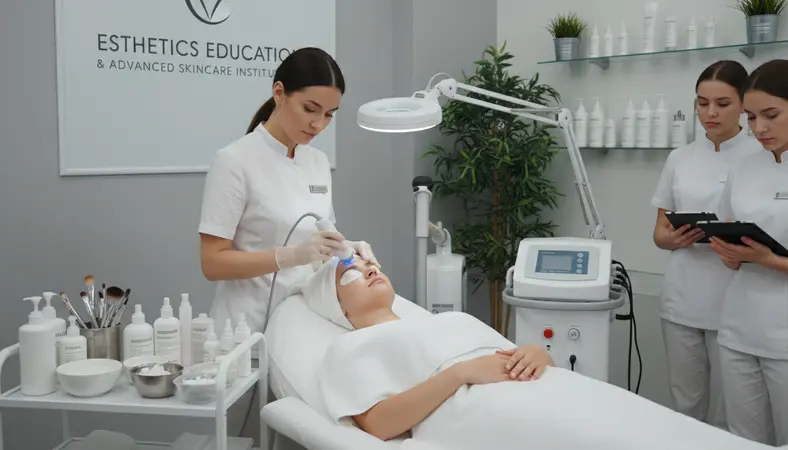
The esthetics profession has evolved dramatically over the past decade. Where estheticians once focused primarily on facials, waxing, and basic skincare, today's advanced estheticians offer a sophisticated menu of clinical treatments that rival the services available in medical spas and dermatology practices. This expansion in services represents an enormous opportunity for estheticians willing to invest in advanced training.
However, expanding your service menu requires more than enthusiasm. It demands a clear understanding of your state's scope of practice regulations, proper training from accredited programs, and a strategic approach to selecting which services will deliver the greatest return for your practice. This guide examines the most impactful advanced services estheticians can add, the training required for each, and the revenue potential that makes the investment worthwhile.
Understanding Scope of Practice
Before exploring specific services, every esthetician must understand the legal framework governing their practice. Scope of practice for estheticians varies significantly by state and is defined by each state's board of cosmetology or health department. What is permitted in one state may be explicitly prohibited in another, and ignorance of these boundaries is not a defense against regulatory action.
In general, estheticians are authorized to perform non-invasive cosmetic treatments that affect the epidermis. Services that penetrate beyond the epidermis, involve injectable substances, or constitute medical procedures typically fall outside the esthetician scope and require a medical license or direct medical supervision. However, the specifics vary enormously. Some states permit estheticians to perform microneedling independently, while others classify it as a medical procedure that requires physician oversight.
Many states distinguish between basic and master or clinical esthetician licenses, with the advanced license permitting a broader range of services. If your state offers an advanced esthetician credential, pursuing it should be a priority, as it immediately expands the services you can legally offer and positions you for roles in medical spa environments where higher-level treatments are the norm.
Always verify your scope of practice with your state board before offering any new service. When in doubt, request a formal written opinion from the board. This documentation protects you in the event of a regulatory inquiry and demonstrates your commitment to practicing within legal boundaries.
Chemical Peels: The Gateway Advanced Service
Chemical peels are often the first advanced service estheticians add because they build naturally on foundational skincare knowledge, offer impressive visible results, and have a relatively low entry cost. Most states permit estheticians to perform superficial chemical peels using alpha hydroxy acids (AHAs) like glycolic acid and lactic acid, beta hydroxy acids (BHAs) like salicylic acid, and low-concentration TCA peels at or below 20 percent.
Superficial peels work by dissolving the intercellular bonds in the stratum corneum, promoting controlled exfoliation that reveals fresher skin underneath. They are effective for treating mild acne, uneven skin tone, fine lines, and dull complexion. Treatment time is typically 15 to 30 minutes, and most clients experience minimal downtime, making chemical peels an easy sell to clients who want visible results without significant recovery.
From a revenue perspective, chemical peels typically command $100 to $250 per treatment, with product costs of $15 to $40 per peel. That yields a gross margin of $60 to $210 per treatment. When offered as part of a series, which is clinically recommended for optimal results, a single client purchasing a six-peel series represents $600 to $1,500 in revenue. Many practices find that chemical peels become their highest-volume advanced service due to the combination of accessibility, affordability for clients, and strong margins.
Training for chemical peels should cover acid chemistry, Fitzpatrick skin typing, contraindications, application technique, neutralization protocols, and complication management. Look for programs that include hands-on application under supervision, as understanding how different skin types respond to chemical agents is a skill that develops through practice, not just theory.
Microneedling: High Demand, High Revenue
Microneedling, also known as collagen induction therapy, has become one of the most requested treatments in aesthetic practice. The procedure uses a device equipped with fine needles to create controlled micro-injuries in the skin, triggering the body's wound healing response and stimulating collagen and elastin production. The result is improved skin texture, reduced scarring, diminished pore size, and overall skin rejuvenation.
The scope of practice for estheticians performing microneedling is one of the most contested areas in esthetics regulation. Some states explicitly permit estheticians to perform microneedling at specific needle depths, typically 0.5 mm or less. Others classify any microneedling as a medical procedure requiring a nursing or medical license. Still others have no specific regulation addressing microneedling, creating a gray area that practitioners must navigate carefully.
Where legally permitted, microneedling is a high-value service. Treatment pricing typically ranges from $250 to $700 per session, with most practitioners recommending a series of three to six treatments spaced four to six weeks apart. Device costs range from $500 for manual rollers to $3,000 to $5,000 for motorized pen devices, and per-treatment cartridge costs run $15 to $30. The return on the initial device investment is typically achieved within the first month of offering the service.
Proper microneedling training must cover device selection and operation, depth settings for different treatment areas, pre-treatment skin preparation, post-treatment protocols, bloodborne pathogen safety, and contraindication screening. This is not a service to add based on a YouTube tutorial. Improper technique can cause scarring, infection, and post-inflammatory hyperpigmentation, outcomes that harm both the client and your reputation.
LED Light Therapy: The Perfect Add-On
LED (light-emitting diode) therapy uses specific wavelengths of light to trigger biological responses in the skin. Red light at 630 to 660 nm stimulates collagen production and reduces inflammation. Blue light at 405 to 420 nm kills Propionibacterium acnes bacteria. Near-infrared light at 810 to 850 nm penetrates deeper to promote tissue repair and reduce pain. The treatment is non-invasive, painless, and has virtually no contraindications or downtime.
LED therapy is permitted within the esthetician scope of practice in virtually every state because it does not penetrate or alter the skin structure. This makes it one of the safest advanced services to add. It also pairs exceptionally well with other treatments. Adding a 15-minute LED session after a facial, chemical peel, or microneedling treatment enhances results and increases the ticket price by $50 to $100 per visit.
Professional-grade LED panels range from $2,000 to $15,000 depending on the number of wavelengths, panel size, and manufacturer. While the upfront investment is significant, the operating cost per treatment is essentially zero since LED diodes last for tens of thousands of hours. At an add-on price of $75 per session, a $5,000 LED panel pays for itself after 67 treatments.
Training for LED therapy should cover the physics of photobiomodulation, wavelength-specific indications, treatment protocols for different conditions, eye safety, and integration with other treatment modalities. While the risk profile is low, understanding the science behind LED therapy enables you to educate clients effectively and tailor protocols to individual needs.
Dermaplaning: Simple, Satisfying, Profitable
Dermaplaning uses a sterile surgical scalpel held at a 45-degree angle to gently scrape the surface of the skin, removing dead skin cells and vellus hair (peach fuzz). The result is immediately smoother, brighter skin with improved product penetration. Clients love the instant gratification of dermaplaning, and the dramatic before-and-after visible difference makes it one of the most Instagram-worthy treatments in esthetics.
Most states allow estheticians to perform dermaplaning, though some require additional certification or limit the blade types that can be used. The treatment takes 20 to 30 minutes and is typically priced at $75 to $150 as a standalone service, or $50 to $75 as an add-on to a facial or peel. Product costs are minimal: a box of 10 sterile surgical blades costs approximately $15, and no topical agents are required during the procedure itself.
Dermaplaning is also an excellent upselling catalyst. Because it removes the dead skin layer and vellus hair, chemical peels and serums applied immediately after dermaplaning penetrate significantly more effectively. Many estheticians offer a "dermaplane and peel" combination treatment at a premium price point, creating a bundled service that delivers superior results and higher revenue per appointment.
Training should emphasize blade angle and pressure control, directional technique for different facial zones, contraindications (including active acne, rosacea, and excessive sun damage), sanitation protocols, and safe blade disposal. Hands-on practice is essential because the haptic feedback of blade against skin cannot be learned from a video.
The Revenue Impact of Service Expansion
Adding even one advanced service to your menu can transform your revenue per client. An esthetician who offers only basic facials at $80 to $120 per treatment is limited in both revenue per visit and client retention. Clients who only receive basic facials tend to visit monthly at best and may not perceive strong differentiation between providers.
An esthetician offering chemical peels, microneedling, LED therapy, and dermaplaning can create customized treatment plans with higher price points and more frequent visits. A client on a six-week microneedling series combined with alternating peel treatments might generate $3,000 to $5,000 in revenue over a six-month period, compared to $500 to $700 from basic facials alone over the same timeframe.
The key is approaching service expansion strategically. Do not add every available treatment simultaneously. Instead, introduce one new service every three to six months, giving yourself time to develop proficiency, build client demand, and establish pricing before adding the next. This measured approach produces better clinical outcomes, stronger client satisfaction, and sustainable business growth.
Training Pathways for Service Expansion
The quality of your training directly determines the quality of your results and the safety of your clients. Cutting corners on education to add services faster is a false economy that eventually manifests as complications, poor outcomes, and reputational damage.
Seek training programs that include both didactic education and supervised hands-on practice. Programs offered by accredited institutions with experienced faculty, live demonstration and practice opportunities, and post-training support produce practitioners who are genuinely competent, not just certified. Facial Injectables offers comprehensive training pathways for estheticians looking to expand their capabilities, with courses designed to build skills progressively and responsibly.
Consider a training membership that provides access to multiple courses over time. This allows you to follow the recommended progression of adding one new service at a time while having immediate access to the training when you are ready for the next step. The membership model also provides ongoing access to updated protocols, community support, and refresher courses as techniques evolve.
Your scope as an esthetician is broader than you might think, and expanding it through proper training is the single most effective way to increase your earning potential, enhance client satisfaction, and build a practice that reflects the full breadth of your capabilities.