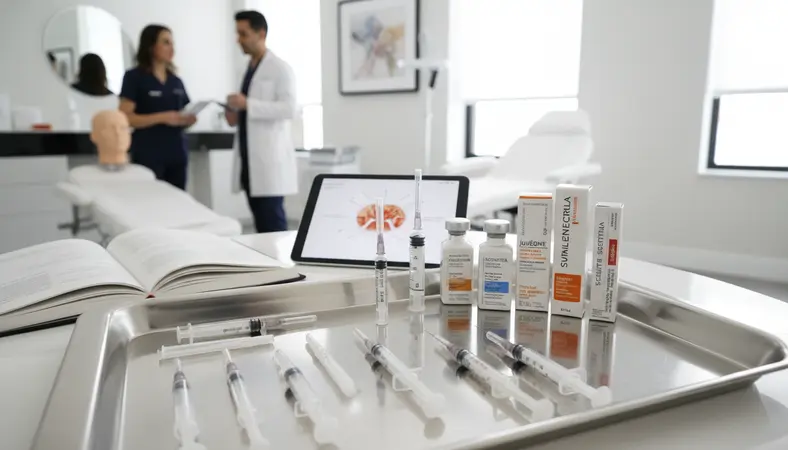
The era of single-product facial rejuvenation is over. Today's most skilled injectors understand that truly natural, comprehensive facial rejuvenation requires a multi-modal approach that combines neurotoxins, hyaluronic acid fillers, biostimulatory agents, and sometimes energy-based devices to address the full spectrum of age-related changes. A patient who presents with dynamic wrinkles, volume loss, skin laxity, and textural changes cannot be adequately treated with Botox alone or fillers alone.
This article explores the principles of combination injectable therapy, treatment sequencing strategies, and the systematic assessment frameworks that advanced injectors use to create comprehensive, individualized treatment plans.
Understanding the Multi-Layered Nature of Facial Aging
Facial aging is not a single process but a convergence of changes across multiple tissue layers. To develop an effective combination treatment plan, you must understand what is happening at each level:
- Skeletal remodeling: The facial skeleton resorbs with age. The maxilla recedes, the mandible loses height and projection, and the orbital aperture widens. These bony changes reduce the structural foundation upon which all soft tissues rest.
- Fat compartment deflation and descent: The face contains discrete superficial and deep fat compartments that deflate and migrate inferiorly with age. The malar fat pad descends, creating nasolabial folds. The buccal fat pad thins, contributing to a gaunt midface.
- Ligamentous laxity: The retaining ligaments that anchor soft tissues to the skeleton weaken, allowing tissue descent. This contributes to jowling and midface ptosis.
- Muscle hyperactivity: Repeated muscle contraction creates dynamic lines that eventually become static wrinkles etched into the skin.
- Skin deterioration: Loss of collagen, elastin, and glycosaminoglycans leads to thinning, loss of elasticity, and textural irregularities.
Each of these processes requires a different therapeutic approach. No single product addresses all five.
The Injectable Toolkit: Product Categories
Neurotoxins
Botulinum toxin type A (Botox, Dysport, Xeomin, Jeuveau, Daxxify) addresses dynamic wrinkles by temporarily reducing muscle contraction. Beyond wrinkle reduction, neurotoxins are used for brow shaping, masseter slimming, neck band treatment, and as a complement to fillers in areas like the lip (lip flip) and chin (mentalis relaxation).
Hyaluronic Acid Fillers
HA fillers come in a range of formulations designed for specific applications. Softer, more cohesive products like Juvederm Volbella and Restylane Silk are designed for lips and superficial lines. Medium-viscosity products like Juvederm Vollure address moderate folds. Firmer, more projecting fillers like Juvederm Voluma and Restylane Lyft provide deep structural support in the midface and jawline. Understanding the rheological properties, meaning the G prime (firmness), cohesivity, and viscosity, of each product is essential for selecting the right filler for each anatomical location.
Biostimulatory Agents
Products like Sculptra (poly-L-lactic acid), Radiesse (calcium hydroxylapatite), and Hyperdilute Radiesse stimulate the body's own collagen production rather than simply filling volume. These agents are particularly valuable for global volume restoration, skin quality improvement, and treating areas where traditional HA fillers may not be ideal, such as the temples, pre-auricular region, and hands.
The MD Codes Approach to Facial Assessment
Developed by Brazilian plastic surgeon Dr. Mauricio de Maio, the MD Codes system provides a systematic, codified approach to facial assessment and treatment planning. Rather than treating individual wrinkles or folds, the system focuses on identifying the emotional expressions a patient's face conveys and which structural changes are responsible for those expressions.
The system categorizes facial concerns into emotional attributes such as looking "tired," "sad," "angry," or "saggy." Each attribute is linked to specific anatomical changes and corresponding treatment codes. For example, a patient who looks "tired" may benefit from under-eye treatment (tear trough and lid-cheek junction), midface volumization, and temporal fossa restoration. A patient who looks "angry" may primarily need glabellar Botox and medial brow filler.
This systematic approach helps injectors create comprehensive treatment plans that address the root causes of facial aging rather than chasing individual lines and shadows. It also provides a framework for prioritizing treatments when budget constraints require staging the treatment plan across multiple sessions.
Treatment Sequencing: Building from the Foundation
When multiple products are indicated, the sequence in which they are administered matters. The most widely accepted approach follows a "deep to superficial" and "structure to refinement" progression:
Session 1: Structural Foundation
Begin with deep structural support. This typically means supraperiosteal filler placement in the midface (malar eminence and zygoma), along the jawline and chin, and in the temples if hollowing is present. Volumizing the deep fat compartments and restoring skeletal projection creates a foundation that elevates and supports the overlying tissues. Many practitioners find that addressing deep structure first reduces the amount of superficial filler needed at subsequent sessions.
Session 2: Refinement (2 to 4 weeks later)
After the structural foundation has settled and any swelling has resolved, reassess the face. Address remaining concerns with neurotoxin for dynamic lines, softer HA fillers for nasolabial folds, marionette lines, and lips, and consider biostimulatory agents for global skin quality improvement. This is also when tear trough and under-eye treatment should be considered, as midface volumization often reduces the appearance of the tear trough.
Session 3: Fine-Tuning
A final session addresses any remaining asymmetries, fine lines, and subtle adjustments. This might include a small amount of superficial filler for perioral lines, a Botox touch-up, or skinbooster injections for overall skin hydration and radiance.
Can You Combine Botox and Fillers in the Same Session?
Yes. Combining neurotoxin and filler in a single appointment is both safe and common in clinical practice. In fact, there are synergistic benefits to combining them. Botox reduces the dynamic forces that break down filler over time, potentially extending filler longevity. Filler addresses the static volume loss that Botox alone cannot correct.
When treating in the same session, many injectors prefer to administer Botox first, followed by filler. The rationale is that filler placement causes more swelling and tissue distortion, which can make precise Botox placement more difficult. However, others prefer filler first so they can assess the need for Botox with the structural changes already in place. Both approaches are acceptable, and the choice often comes down to practitioner preference and clinical experience.
Patient Assessment for Multi-Modal Treatment
A thorough patient assessment for combination therapy should include evaluation at rest and in animation, assessment of skin quality and texture, evaluation of facial proportions and symmetry, discussion of the patient's primary concerns and priorities, realistic budget assessment, and medical history review including previous injectable treatments and any complications.
Photograph the patient from multiple angles: frontal, oblique, and lateral views, both at rest and during animation. These images serve as your treatment planning reference, before-and-after documentation, and medicolegal protection.
Developing expertise in multi-modal facial rejuvenation requires advanced training that goes beyond basic certification. Our Advanced Botox and Filler Training program covers combination treatment planning, advanced filler placement techniques, and the clinical decision-making skills needed to create comprehensive rejuvenation plans. For practitioners looking to add structural lifting techniques, our PDO Thread Lift Training provides another powerful tool for your rejuvenation toolkit.