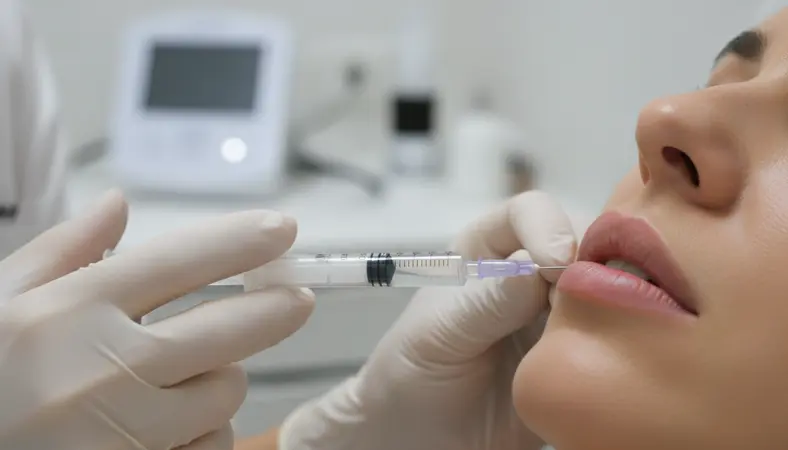
Successful lip augmentation begins with a thorough understanding of lip anatomy. The lips are among the most complex structures in the face, combining a muscular sphincter, mucosal tissue, multiple arterial supplies, and dense sensory innervation in a relatively small area. For injectable practitioners, knowing the precise location of every structure within and around the lips is not optional: it is the foundation upon which safe, effective treatment is built.
This article provides a detailed anatomical guide to the lips, mapping the key structures that every injector must understand, and identifying the safe injection zones that minimize risk while maximizing aesthetic outcomes.
Surface Anatomy and Landmarks
Before examining the deeper structures, it is important to define the surface landmarks that guide lip injection. These landmarks serve as your reference points during treatment and should be identified and assessed on every patient during consultation.
- Cupid's bow: The double-curved shape of the upper lip border, named for its resemblance to the bow of Cupid. The two highest points of the curve are the Cupid's bow peaks, which form the most projecting portions of the upper lip vermillion border.
- Philtral columns: Two vertical ridges extending from the base of the nose (the columella) to the Cupid's bow peaks. These columns frame the philtral groove (the concavity between them) and create the visual "scaffolding" of the upper lip.
- Vermillion border (white roll): The distinct line separating the red lip (vermillion) from the surrounding skin. Anatomically, this border is created by a ridge of orbicularis oris muscle fibers covered by thinning skin, creating a natural light-catching edge that defines the lip outline.
- Wet-dry junction: The border between the external dry mucosa of the lip (visible when the mouth is closed) and the internal wet mucosa. This junction is approximately 3 to 5 mm inside the vermillion border on the lip body.
- Commissures: The corners of the mouth where the upper and lower lips meet. The commissure position and angle significantly affect facial expression; downturned commissures convey sadness or aging.
- Tubercle: The central fullness of the upper lip, located between the two philtral columns. This is the most projecting point of the upper lip when viewed in profile.
Muscular Anatomy: The Orbicularis Oris
The orbicularis oris is the primary muscle of the lips. Unlike the simple sphincter description found in basic anatomy texts, the orbicularis oris is actually a complex of four semi-independent quadrants of muscle fibers that interdigitate with numerous other facial muscles inserting into the lip region.
The orbicularis oris has two main components:
- Pars marginalis: The fibers running along the free edge of the lip, within the vermillion. These fibers are responsible for lip pursing, fine lip movements during speech, and controlling the lip margin position. They lie superficially, just beneath the mucosal surface.
- Pars peripheralis: The deeper, more peripheral fibers that extend from the vermillion border toward the nasolabial fold superiorly and the labiomental crease inferiorly. These fibers provide the structural framework of the lip.
Multiple other muscles insert into or blend with the orbicularis oris, including the levator labii superioris, zygomaticus major and minor, buccinator, depressor labii inferioris, depressor anguli oris, mentalis, and platysma. This complex muscular interplay is why lip movement is so nuanced and why inappropriate Botox placement around the lips can have significant functional consequences, affecting speech, drinking, and facial expression.
Vascular Supply: The Labial Arteries
The vascular anatomy of the lips is the most critical safety consideration for injectable practitioners. The lips receive their primary blood supply from the superior and inferior labial arteries, branches of the facial artery.
Superior Labial Artery
The superior labial artery branches from the facial artery near the oral commissure and courses medially within the upper lip. Its depth and position are highly variable, which is what makes lip injection inherently risky. Studies have shown that the superior labial artery runs within the orbicularis oris muscle in approximately 60% of cases, superficial to the muscle in about 25%, and deep to the muscle (submuscular) in about 15%.
Most commonly, the artery is found at a depth of 3 to 5 mm from the mucosal surface, running 3 to 6 mm from the vermillion border within the lip body. However, these averages mask significant individual variation. The artery may run as superficially as 2 mm or as deep as 8 mm from the mucosal surface.
Inferior Labial Artery
The inferior labial artery follows a similar course within the lower lip. It typically runs in a deeper plane than the superior labial artery, within the substance of the orbicularis oris. The inferior labial artery is generally more consistent in its position but can be absent unilaterally in up to 15% of individuals, with the contralateral artery providing blood supply to both sides.
Clinical Significance
The variability in labial artery position means that no single injection depth can be considered universally "safe." This is why aspiration before injection, slow injection speed, and small aliquot sizes are essential safety practices during lip filler treatment. Intravascular injection can cause acute lip necrosis, significant pain, and disfiguring scarring.
Safe Injection Zones
While no area of the lip is completely without vascular risk, certain zones and depths carry lower risk profiles:
- Vermillion border (superficial): Injecting at the level of the white roll, in the subdermal plane just beneath the skin, places filler superficial to the orbicularis oris and typically above the course of the labial arteries. This is the safest zone for border definition work.
- Lip body (submucosal): Injecting just beneath the mucosa, between the mucosal surface and the orbicularis oris muscle, places filler superficial to the most common arterial course. This zone is appropriate for volume enhancement using soft fillers.
- Deep to orbicularis oris: Injecting beneath the muscle, in the submuscular plane against the gingival tissue, places filler in a deeper plane. This approach is sometimes used for significant volume augmentation but requires careful technique as the arteries may course in this plane in a subset of patients.
Sensory Innervation
The upper lip receives sensory innervation from the infraorbital nerve (a branch of the maxillary division of the trigeminal nerve, V2), while the lower lip is innervated by the mental nerve (a branch of the mandibular division, V3). Understanding these nerve distributions is important for both anesthesia planning and for recognizing nerve-related complications.
Infraorbital and mental nerve blocks can provide excellent anesthesia for lip injection when topical anesthesia alone is insufficient. The infraorbital nerve is blocked at the infraorbital foramen (located approximately 1 cm below the orbital rim in the mid-pupillary line), and the mental nerve is blocked at the mental foramen (located below the second premolar on the mandible).
Developing a three-dimensional understanding of lip anatomy is best achieved through hands-on study. Our Cadaver Lab Injection Anatomy course provides unparalleled anatomical education, while our Lip Filler Certification translates that anatomical knowledge into practical injection skills with live patient training.