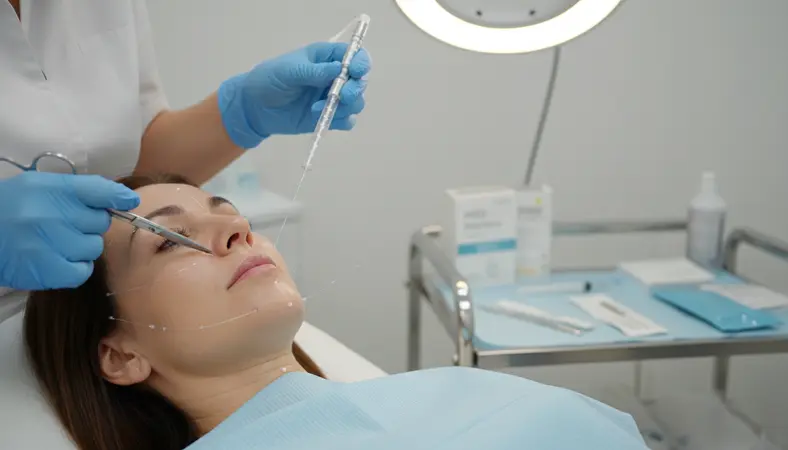
The facelift has long been considered the gold standard for facial rejuvenation, but for the millions of patients who desire visible improvement without the risks, cost, and downtime of surgery, PDO thread lifting has emerged as a compelling alternative. Using absorbable polydioxanone sutures to mechanically lift sagging tissue and stimulate natural collagen production, thread lifts bridge the gap between non-invasive treatments like Botox and fillers and full surgical intervention. For aesthetic practitioners, adding PDO thread lifting to your service menu represents one of the most significant revenue opportunities in modern aesthetic medicine.
How PDO Threads Work
Polydioxanone (PDO) is a synthetic absorbable polymer that has been used in surgery for over three decades, most notably as suture material in cardiovascular and orthopedic procedures. Its safety profile is well-established, and its predictable absorption timeline makes it an ideal material for aesthetic thread lifting.
PDO thread lifting works through two distinct mechanisms that operate on different timescales. The immediate mechanism is mechanical: barbed threads are inserted into the subcutaneous tissue using a needle or cannula, and the directional barbs anchor into the tissue, allowing the practitioner to reposition and elevate descended soft tissue along a defined vector. This mechanical lifting effect is visible immediately after the procedure, though the final result becomes more apparent as swelling subsides over the following one to two weeks.
The secondary mechanism is biostimulatory. The presence of the PDO material in the tissue triggers a controlled foreign body response that activates fibroblasts—the cells responsible for producing collagen. Over the three to six months following thread placement, new type I and type III collagen is deposited along the thread tract, creating a natural support scaffold that persists long after the PDO material has been fully absorbed. This neocollagenesis is the reason that many patients report their results continuing to improve for several months after the procedure.
The Science of Collagen Stimulation
The collagen stimulatory effect of PDO threads is one of their most valuable properties and distinguishes thread lifting from purely mechanical procedures. The biological cascade proceeds through several well-documented stages:
Acute inflammatory phase (days 1-7): The insertion of the PDO thread triggers an acute inflammatory response characterized by neutrophil and macrophage infiltration. This is a normal and desirable response that initiates the tissue remodeling process.
Proliferative phase (weeks 1-12): Fibroblasts are recruited to the area and begin synthesizing new collagen fibers, predominantly type III collagen initially. New blood vessels form (neoangiogenesis), improving tissue perfusion and skin quality in the treated area.
Remodeling phase (months 3-12): Type III collagen is gradually replaced by stronger type I collagen fibers, and the collagen matrix organizes along the lines of mechanical tension created by the thread. The PDO material is fully absorbed through hydrolysis by approximately six to eight months, but the collagen scaffold it stimulated remains, providing ongoing structural support.
Histological studies have confirmed significant increases in dermal collagen density, elastin fiber organization, and tissue vascularity following PDO thread placement. These changes translate to measurable improvements in skin thickness, elasticity, and overall quality that patients notice as firmer, more radiant skin.
Procedure Overview
A typical PDO thread lift procedure takes 30 to 60 minutes and can be performed in an outpatient clinical setting under local anesthesia. The general workflow includes:
- Consultation and treatment planning: Assess the patient's facial anatomy, degree of laxity, skin quality, and aesthetic goals. Design the thread placement vectors and mark the entry points, exit points, and lifting directions on the skin.
- Preparation: Cleanse the treatment area with antiseptic solution (typically chlorhexidine or povidone-iodine). Apply topical anesthetic cream 20-30 minutes before the procedure, followed by local infiltration anesthesia (lidocaine with epinephrine) at the entry points and along the planned thread tracts.
- Thread insertion: Insert the pre-loaded needle or cannula through the entry point, advance it along the planned vector through the subcutaneous tissue, and deploy the thread. For barbed threads, the barbs engage the tissue as the needle is withdrawn, creating the lifting effect.
- Tissue adjustment: After all threads are placed, gently massage and mold the tissue to optimize the lifting effect and smooth any irregularities. This step requires a delicate touch and a trained aesthetic eye.
- Post-procedure care: Apply cold compresses, provide aftercare instructions, and schedule a follow-up appointment for one to two weeks post-procedure.
Recovery and Aftercare
One of the primary advantages of PDO thread lifting over surgical facelift is the dramatically reduced recovery time. Most patients can return to normal daily activities within one to three days, with the following typical recovery timeline:
- Days 1-3: Mild to moderate swelling, possible bruising at entry points, and a sensation of tightness in the treated area. Patients should avoid excessive facial movements (wide yawning, aggressive chewing) and sleep on their back with the head elevated.
- Days 3-7: Swelling begins to resolve. Patients may feel a mild pulling sensation when making facial expressions, which is normal and indicates that the threads are properly engaged. Light makeup can typically be applied after 48 hours.
- Weeks 1-2: Most visible swelling and bruising has resolved. Patients can resume normal activities including light exercise. Avoid vigorous exercise, saunas, and facial massage for at least two weeks.
- Weeks 2-4: The tissue settles into its final position as post-inflammatory swelling fully resolves. The true lifting result becomes apparent during this period.
Patient aftercare instructions should emphasize avoiding dental procedures for two weeks (to minimize jaw manipulation), refraining from facial massage or aggressive skin care treatments for four weeks, and sleeping face-up for at least one week. Anti-inflammatory medications such as ibuprofen may be used for comfort but should be balanced against their blood-thinning effects.
Longevity of Results
The longevity of PDO thread lift results depends on several factors including the type of threads used, the number of threads placed, the patient's age and skin quality, and their rate of ongoing facial aging. On average, patients can expect the following timeline:
The mechanical lifting effect from barbed threads is most pronounced during the first six to twelve months. As the PDO material is absorbed (typically complete by six to eight months), the mechanical lift gradually transitions to biostimulatory support from the newly formed collagen. The net result is that most patients maintain visible improvement for 12 to 18 months, with some reporting benefits lasting up to two years.
Smooth threads used for skin rejuvenation typically provide results lasting 6 to 12 months, primarily through the collagen stimulatory effect. Many practitioners recommend a maintenance protocol of smooth thread treatment every 6 to 12 months to sustain ongoing collagen remodeling.
Patient Satisfaction Data
Patient satisfaction with PDO thread lifting is consistently high when patients are properly selected and their expectations are appropriately managed. Published studies report satisfaction rates ranging from 75% to 95%, with the highest satisfaction observed in patients with mild-to-moderate laxity who are seeking noticeable but natural-looking improvement.
A 2020 systematic review published in the Aesthetic Surgery Journal analyzed 40 studies involving over 2,000 patients and found that PDO thread lifting produced statistically significant improvements in facial laxity as measured by objective photographic assessment, with complication rates below 5% when performed by trained practitioners. The most common complications were minor and self-limiting, including temporary bruising (12%), mild swelling (8%), and transient dimpling at entry points (3%).
Patients who are least satisfied with thread lifting are typically those with expectations that exceed what the procedure can realistically deliver—particularly patients with severe laxity who need surgical intervention, or patients expecting results identical to a surgical facelift. Thorough pre-procedure consultation that clearly communicates expected outcomes is essential for maintaining high satisfaction rates.
Facial Injectables offers comprehensive PDO thread training at multiple skill levels. Our PDO Thread Lift Training provides foundational skills for practitioners new to thread lifting, while our Advanced PDO Thread Certification covers complex techniques for experienced practitioners. For those interested in smooth thread applications, our Smooth Thread Rejuvenation Course focuses specifically on biostimulatory techniques for skin quality improvement.